








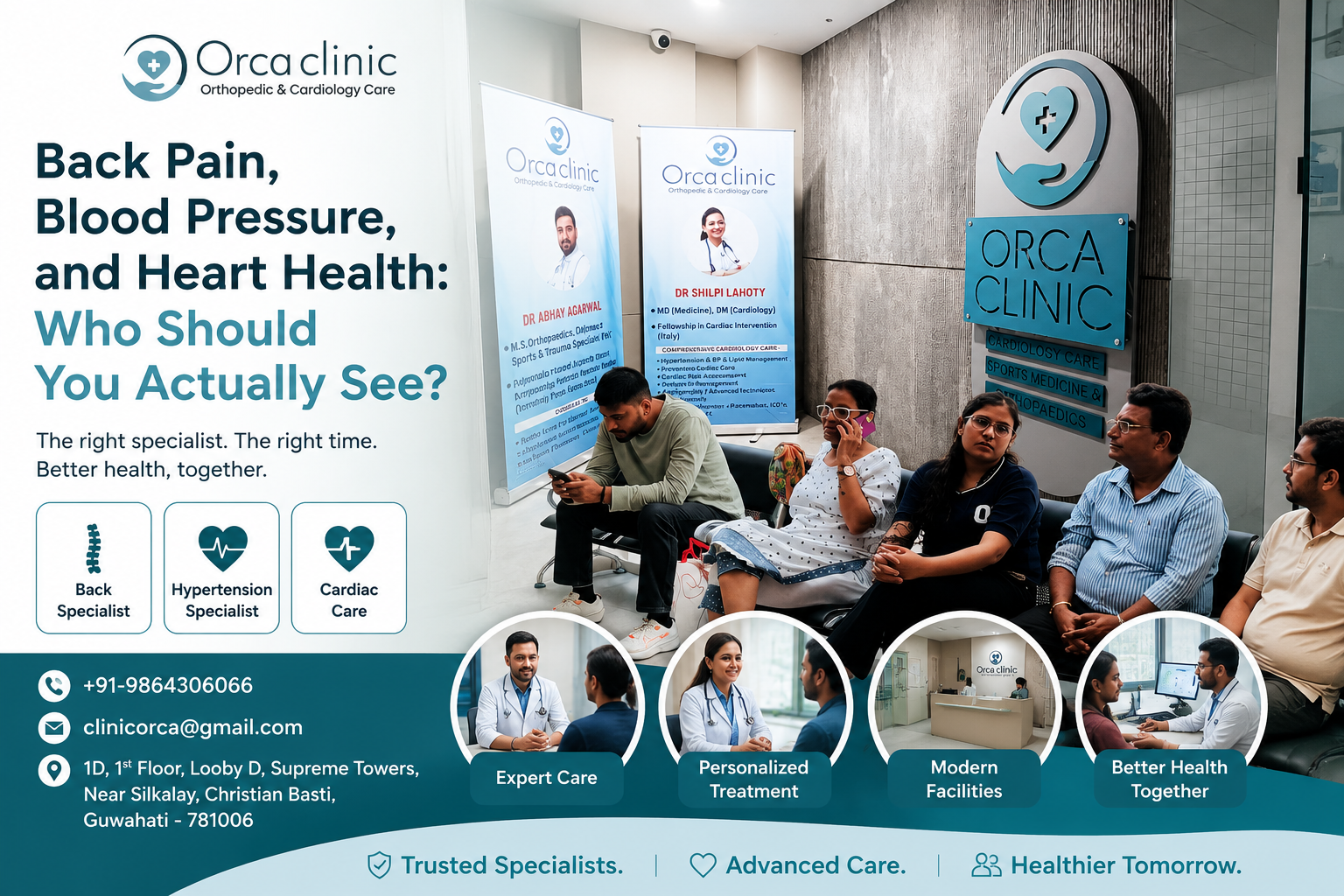
Back Pain, Blood Pressure, and Heart Health: Who Should You Actually See?
A patient walked into Orca Clinic last month holding two reports in her hand. One was for a stubborn ache in her lower back that had been bothering her for three months. The other was a blood pressure reading from a pharmacy machine that had quietly crossed 150/95 twice in the same week. She had one question: “Which doctor do I even need?”
It’s a more common situation than most people realise. Back pain and high blood pressure rarely announce themselves as emergencies. They build up slowly, get blamed on stress or age, and get pushed down the to-do list until they can’t be ignored anymore. This guide is written for exactly that moment of confusion: to help you understand when a search for a “back specialist near me” is warranted, when it’s time to consult a hypertension specialist in Guwahati, and how cardiac centres and heart doctors across India fit into the picture.
When a “Back Specialist Near Me” Search Actually Makes Sense
Most people try to manage back pain on their own first a hot water bag, a painkiller, a few days of rest. That’s reasonable for a pulled muscle. But there’s a point where self-management stops being enough, and typing “back specialist near me” into your phone is the right next step rather than a last resort.
Pay attention if your back pain:
- Has lasted more than three to four weeks without real improvement
- Gets worse when you sit, stand, or climb stairs for extended periods
- Comes with stiffness that’s noticeably worse first thing in the morning
- Is accompanied by numbness, tingling, or weakness in the legs
- Started after a fall, an accident, or even seemingly minor trauma
What surprises a lot of patients is that persistent back pain is sometimes the first visible sign of something happening underneath spinal arthritis, degenerative disc changes, or in older adults, osteoporosis-related compression in the vertebrae. Our detailed guide on arthritis and osteoporosis care in Guwahati covers this connection in more depth, including the diagnostic steps a good orthopedic specialist will take before jumping to treatment.
A proper evaluation from a back specialist near me should never begin with a prescription. It should begin with questions about how the pain behaves, what makes it better or worse, your posture and daily habits, and your family history followed by a physical examination and, where needed, imaging or bone density testing. That sequence matters more than how quickly you get a medicine in hand.
Choosing a Hypertension Specialist in Guwahati: What Good Care Looks Like
High blood pressure is sometimes called the “silent” condition, and that description holds up in clinical practice. Many patients in Guwahati find out they have hypertension almost by accident during a routine check-up, an insurance medical, or, like the patient mentioned earlier, a stray reading at a pharmacy.
The trouble with silence is that it breeds delay. People assume that because they feel fine, the number on the monitor can wait. It usually can’t. Sustained high blood pressure works quietly on the arteries, the heart muscle, the kidneys, and even the eyes, long before any obvious symptom shows up.
A hypertension specialist in Guwahati brings three things to the table that a one-off reading at home cannot:
Context. A single elevated reading isn’t a diagnosis. A specialist looks at your readings over time, your family history, your weight, salt intake, sleep patterns, and stress levels before deciding whether and how to treat.
Titration. Blood pressure medication isn’t a fixed dose for life. It needs to be adjusted as your body responds, as seasons change, and as other health factors shift. This is where regular follow-up with a hypertension doctor genuinely changes outcomes.
Connected care. Blood pressure rarely travels alone. It’s frequently paired with high cholesterol, and both influence long-term heart risk together. That’s exactly why our hypertension and lipid management programme in Guwahati treats blood pressure and cholesterol as one connected picture rather than two separate problems.
If you’ve been putting off a visit because your readings aren’t “that high yet,” that’s precisely the stage where a hypertension specialist in Guwahati can do the most good before medication becomes the only option left.
Cardiac Centers: What They’re Actually For (and When You Need One)
The term “cardiac centre” gets used loosely, and that causes some confusion. Not every visit to a cardiac centre means something is seriously wrong. In fact, the most valuable work that happens at good cardiac centers is preventive catching risk early, long before a patient ever needs an ambulance.
A well-run cardiac centre typically offers a few layers of care:
- Diagnostic evaluation — ECG, ECHO, Holter monitoring, and TMT (treadmill stress testing) to understand how the heart is functioning under rest and exertion
- Risk-factor management — blood pressure, cholesterol, blood sugar, and weight, since these four together drive most cardiovascular disease
- Preventive counselling — practical, individualised guidance on diet, activity, and stress rather than generic pamphlets
- Follow-up and monitoring — because heart health isn’t a one-time test, it’s an ongoing relationship
You don’t need to be having chest pain to walk into a cardiac centre. If you have a family history of heart disease, you smoke, you’re diabetic, you’ve been sedentary for years, or you’re recovering from an earlier cardiac event, preventive evaluation is exactly what’s designed for you. Our page on preventive cardiology services in Guwahati breaks down exactly who benefits most from this kind of proactive care and what a typical evaluation involves.
The mindset shift that matters here: think of a cardiac centre as somewhere you go to stay ahead of a problem, not just somewhere you end up after one has already happened.
Researching a Medica Cardiologist? Here’s What to Actually Compare
Many patients researching heart care in this region come across the term “Medica cardiologist” while comparing options. Medica being a well-known hospital name across Eastern India. If that’s part of your search, it’s worth stepping back and asking what actually matters in that comparison, beyond the name on the building.
When evaluating any cardiologist, whether at a large hospital chain or a focused clinic, these are the questions worth asking:
- How much time will the doctor actually spend with me? Larger hospital settings can sometimes mean shorter, more rushed consultations simply due to patient volume.
- Will I see the same doctor at every follow-up? Continuity of care matters enormously for a chronic condition like hypertension or heart disease — a new doctor each visit means re-explaining your history every time.
- Is the focus purely diagnostic, or is there ongoing management? Some centres are excellent for one-time testing but less equipped for the months and years of follow-up that heart care actually requires.
- How accessible is the doctor between visits? Questions come up between appointments. Being able to reach your cardiologist’s team matters more than most patients realise until they need it.
This isn’t about one option being universally better than another — it’s about matching the kind of care you need with the kind of setting that provides it. At Orca Clinic, our approach leans toward smaller patient loads, direct access to your treating doctor, and continuity between your orthopedic and cardiology care when both are relevant — something worth weighing alongside any larger hospital name you’re considering.
The Bigger Picture: Why India Needs More Accessible Hypertension Care
Zoom out from Guwahati for a moment, and the numbers tell a sobering story. Hypertension affects roughly one in four adults in India, and a large share of them don’t know they have it. Rising salt intake, sedentary urban lifestyles, stress, and genetics have combined to make high blood pressure one of the country’s most under-diagnosed conditions.
What makes this especially frustrating from a clinical standpoint is that hypertension is one of the most manageable chronic conditions there is when it’s caught and treated consistently. A hypertension doctor in India today isn’t just prescribing tablets; the better ones are also working on:
- Making blood pressure checks a normal part of every routine visit, not just cardiology ones
- Educating patients on home monitoring, so problems are caught between visits, not just during them
- Addressing lifestyle factors – diet, sleep, alcohol, and activity as seriously as medication
- Building long-term relationships with patients rather than one-off consultations
Guwahati, like many growing Indian cities, is seeing this shift firsthand. More people are checking their blood pressure earlier, more workplaces are running basic health camps, and more patients are asking better questions before their numbers become a crisis. That trend is worth encouraging, not just at a national level, but one appointment at a time.
Bringing It Together: Orthopedic and Cardiac Care Under One Roof
Here’s something that doesn’t get discussed enough: back pain and heart health are more connected than people assume. Chronic pain limits physical activity. Reduced activity contributes to weight gain and poor cardiovascular fitness. Poor cardiovascular fitness, in turn, makes recovery from joint and bone conditions slower. It’s a loop, and breaking it usually works best when both sides are treated by a team that talks to each other.
That’s the thinking behind how Orca Clinic is structured orthopedic care led by Dr. Abhay Agarwal and cardiology care led by Dr. Shilpi Lahoty, working from the same clinic rather than two disconnected practices. If you’d like a broader sense of how this combined approach plays out for real patients, our orthopedic and cardiology health blog covers a range of conditions and patient questions we see regularly at the clinic.
Whether you’re dealing with a back that won’t loosen up, a blood pressure reading that keeps creeping higher, or you simply want a proper baseline check-up before something becomes a problem, the starting point is the same: don’t wait for the pain or the numbers to force your hand.
Frequently Asked Questions
How urgently should I see a back specialist near me?
If your back pain has lasted beyond three to four weeks, disrupts sleep, or comes with numbness or weakness in your legs, it’s time to book an evaluation rather than wait it out. Sudden, severe pain after a fall or accident should be assessed immediately, since delayed evaluation can allow underlying issues like fractures or nerve compression to worsen.
What does a hypertension specialist in Guwahati actually check during a first visit?
Expect a review of your blood pressure trend (not just one reading), family history, weight, lifestyle habits, and often basic blood work to check cholesterol and kidney function. The goal is to understand the full risk picture before deciding whether lifestyle changes alone are enough or medication is needed.
Are cardiac centers only for people who already have heart disease?
No. A significant part of what cardiac centers do is preventive assessing risk in people who feel perfectly healthy but have risk factors like family history, smoking, diabetes, or high cholesterol. Waiting for symptoms before visiting a cardiac centre often means waiting too long.
Is it better to see a Medica cardiologist or a smaller, focused clinic?
There’s no single right answer ,it depends on what you value. Larger hospital networks offer scale and infrastructure, while smaller, focused clinics often offer more consultation time, easier access to the same treating doctor, and closer follow-up. It’s worth comparing consultation length, continuity of care, and follow-up access rather than the hospital name alone.
Why is India seeing more demand for hypertension doctors?
Rising urban stress, dietary salt intake, sedentary routines, and genetic predisposition have made hypertension increasingly common across India, with a large proportion of cases still undiagnosed. As awareness grows through routine screenings and workplace health checks, more people are consulting a hypertension doctor before complications like heart or kidney damage set in, rather than after.
Can back pain and heart health be related?
Indirectly, yes. Chronic back pain often reduces physical activity, which affects cardiovascular fitness and weight over time. This is one reason an integrated approach where your orthopedic and cardiology care are coordinated tends to produce better long-term outcomes than treating each issue in isolation.
How often should I get my blood pressure and joints checked if I have no symptoms?
For adults over 30, an annual blood pressure check is a reasonable baseline, more frequently if you have risk factors like obesity, diabetes, or a family history of hypertension. Joint and bone health check-ins become more relevant after 40, especially for those with a sedentary lifestyle or a family history of arthritis or osteoporosis.
Talk to Our Team
If you’re dealing with persistent back pain, unpredictable blood pressure readings, or simply want a proper baseline heart evaluation, Orca Clinic in Christian Basti, Guwahati, brings orthopedic and cardiology care together under one roof.
📍 1D, 1st Floor, Looby D, Supreme Towers, Near Silkalay, Christian Basti, Guwahati – 781006 📞 +91-9864306066
✉ clinicorca@gmail.com