








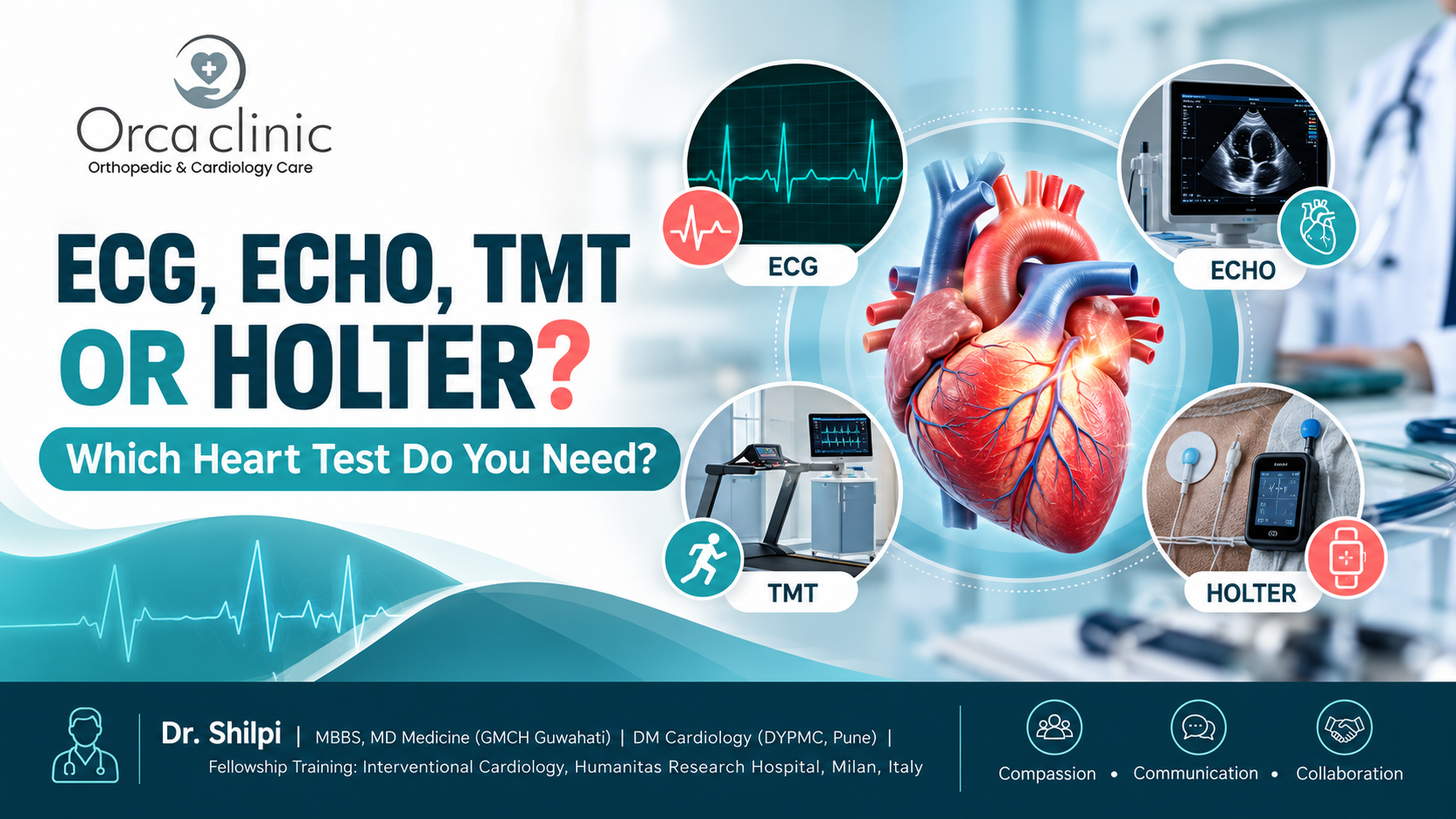
ECG, ECHO, TMT or Holter? Which Heart Test Do You Need?
Chest discomfort after climbing stairs. A fluttering feeling in your chest at night. Sudden breathlessness, or a family history that keeps you worried. When symptoms like these appear, your doctor may advise one or more heart tests in Guwahati, and the names can feel confusing: ECG, ECHO, TMT, Holter.
The good news is that each test answers a different question about your heart. In this guide, we explain what each one does, who needs it and how your cardiologist decides which test is right for you.
Why Are Heart Tests Important?
Heart disease often develops silently. Blockages, rhythm problems and weak heart muscle can exist for years before they cause a serious event. Timely testing helps to:
- Find problems early, when treatment is simpler and more effective
- Explain symptoms such as chest pain, palpitations, dizziness or breathlessness
- Check how well your heart is working before surgery or starting an exercise programme
- Monitor an existing heart condition or the effect of medicines
A proper cardiac evaluation always starts with your history, symptoms and a physical examination. Tests are then chosen to match your situation, not the other way round.
ECG Test in Guwahati: The First Step
What it is: An ECG (electrocardiogram) records the electrical activity of your heart using small sticky electrodes placed on your chest, arms and legs.
What it shows:
- Irregular heartbeat (arrhythmia)
- Signs of a previous or ongoing heart attack
- Strain on the heart muscle
- Slow or fast heart rate
What to expect: The ECG test in Guwahati takes only a few minutes, is painless and needs no special preparation. Wear loose, comfortable clothing.
Limitation: A standard ECG captures just a few seconds of your heartbeat. If your problem comes and goes, a resting ECG can look completely normal. That is where other tests help.
ECHO Test in Guwahati: A Picture of Your Heart
What it is: An echocardiogram (ECHO) uses ultrasound waves to create a live moving image of your heart. There is no radiation and no needle.
What it shows:
- Size and shape of the heart chambers
- How strongly the heart pumps (ejection fraction)
- Condition of the heart valves, including leaks or narrowing
- Areas of heart muscle damage after a heart attack
- Fluid around the heart and certain congenital defects
What to expect: You lie on your side while a technician moves a small probe, with gel, over your chest. The ECHO test in Guwahati is painless and usually takes around 20 to 40 minutes.
Who needs it: People with breathlessness, swelling in the legs, a heart murmur, suspected heart failure, valve disease, or an abnormal ECG.
TMT Test (Treadmill Stress Test): How Your Heart Behaves Under Stress
What it is: A TMT records your ECG, heart rate and blood pressure while you walk on a treadmill that gradually increases in speed and incline.
Why it matters: Some blockages in the heart arteries do not show up at rest. They appear only when the heart works harder and needs more blood. The TMT test is designed to reveal exactly that.
What it shows:
- Whether the heart gets enough blood flow during exertion
- Exercise-induced rhythm problems
- Your exercise capacity and blood pressure response
- Possible reason behind chest pain or breathlessness on effort
What to expect: The test is supervised closely by a doctor and technician and generally takes about 15 to 30 minutes, including preparation. Wear comfortable clothes and walking shoes, and follow your doctor’s advice about food and medicines before the test. Tell the team if you have joint pain, breathing problems or any recent symptoms.
Note: A TMT is not suitable for everyone, for example people with unstable chest pain or certain severe conditions. Your cardiologist will decide if it is safe for you.
Holter Monitoring: Catching What Comes and Goes
What it is: A Holter monitor is a small, portable ECG recorder that you wear for 24 to 48 hours (sometimes longer) while you go about your normal day and night.
What it shows:
- Occasional palpitations or skipped beats
- Episodes of very fast or very slow heart rate
- Rhythm changes during sleep, work or activity
- Whether symptoms such as dizziness or fainting match a rhythm problem
- How well rhythm medicines are working
What to expect: Electrodes are attached to your chest and connected to a small device worn on a strap or belt. You note your symptoms and the time in a diary. Keep the device dry, so avoid bathing while wearing it. The next day the recording is removed and analysed by your cardiologist.
Who needs it: Anyone whose symptoms are occasional and unpredictable, which a short ECG may miss.
ECG vs ECHO vs TMT vs Holter: Quick Comparison
| Test | What it checks | Best for | Typical duration |
| ECG | Electrical activity at rest | Quick screening, rhythm problems, past heart attack | A few minutes |
| ECHO | Heart structure, valves and pumping strength | Breathlessness, murmurs, heart failure, valve disease | 20 to 40 minutes |
| TMT | Heart response during exercise | Chest pain on exertion, suspected blockages | 15 to 30 minutes |
| Holter | Heart rhythm over 24 to 48 hours | Palpitations, dizziness, fainting | 1 to 2 days of wearing |
So, Which Heart Test Do You Need?
Only your cardiologist can decide this after examining you, but these common scenarios give a general idea:
- Chest pain or pressure while walking or climbing stairs: Usually an ECG first, followed by a TMT and sometimes an ECHO.
- Racing, fluttering or skipped heartbeats that come and go: ECG and Holter monitoring.
- Breathlessness, tiredness or swollen feet: ECHO along with an ECG.
- Dizziness or fainting episodes: ECG, Holter monitoring and often an ECHO.
- Family history of heart disease, diabetes, high blood pressure or high cholesterol: A baseline ECG and a broader cardiac evaluation, with TMT or ECHO if needed.
- Heart murmur heard by a doctor: ECHO.
- Planning surgery or a new exercise programme: ECG, and possibly ECHO or TMT, depending on your age and health.
Often, several tests work together. An ECG may raise a question that an ECHO answers, and a TMT may show whether further investigation is needed.
When Should You Not Wait?
Some symptoms need urgent medical attention. Go to the nearest emergency department immediately if you have:
- Severe or crushing chest pain or pressure, especially with sweating, nausea or pain spreading to the arm, jaw or back
- Sudden severe breathlessness
- Fainting with palpitations
- Sudden weakness, trouble speaking or face drooping
Do not wait for a scheduled test in these situations.
Complete Cardiac Evaluation at Orca Clinic, Guwahati
At Orca Clinic, our cardiology team offers ECG, ECHO, TMT and Holter monitoring along with a comprehensive cardiac evaluation for conditions such as coronary artery disease, arrhythmias, heart failure and valve disease. Our approach is simple: listen carefully, choose only the tests that are truly needed, explain the results in plain language and build a treatment or prevention plan that fits you.
Learn more about our ECG, ECHO, Holter and TMT services and our comprehensive cardiac evaluation. You can also read about our preventive cardiology care and our recent guide on when chest pain is an emergency.
Frequently Asked Questions (FAQs)
Where can I get heart tests in Guwahati?
Orca Clinic, located at Supreme Towers, Christian Basti, Guwahati, offers ECG, ECHO, TMT and Holter monitoring along with consultation with a cardiologist, so you can get tests and expert interpretation in one place.
What is the difference between ECG and ECHO?
An ECG records the electrical signals of your heart and is useful for rhythm problems and signs of heart attack. An ECHO uses ultrasound to show the structure of the heart, the valves and how well the heart pumps. They answer different questions and are often done together.
Is the ECG test in Guwahati painful?
No. An ECG is completely painless. Electrodes are placed on your skin and the test takes only a few minutes.
Is an ECHO test safe? Does it involve radiation?
An ECHO uses sound waves, not radiation, so it is considered safe and can be repeated when needed.
Do I need to fast before an ECHO or TMT?
An ECHO usually needs no special preparation. For a TMT, avoid a heavy meal just before the test and follow your doctor’s instructions about medicines. Always confirm preparation with the clinic when you book.
Who should get a TMT test?
A TMT is commonly advised for people who have chest pain or breathlessness on exertion, or who have risk factors for coronary artery disease. Your cardiologist will decide if it is suitable for you.
How long do I have to wear a Holter monitor?
Usually 24 to 48 hours. In some cases, your doctor may advise a longer period. You can continue your normal routine, but keep the device dry.
Can I have a normal ECG and still have heart disease?
Yes. A resting ECG can be normal in people with blockages or occasional rhythm problems. This is why your doctor may suggest TMT, ECHO or Holter monitoring when symptoms persist.
How often should I get my heart checked?
It depends on your age, symptoms and risk factors such as diabetes, high blood pressure, high cholesterol, smoking or family history. Adults over 40, and younger people with risk factors, should ask their doctor about a regular schedule of checks.
Do I need a referral for these tests?
You can book a consultation with a cardiologist directly, who will examine you and advise only the tests that you need.
Book Your Heart Check-Up
Don’t ignore chest discomfort, palpitations or breathlessness, and don’t guess which test you need. A short consultation can give you clarity.
Orca Clinic 1D, 1st Floor, Looby D, Supreme Towers, Near Silkalay, Christian Basti, Guwahati – 781006
Phone: +91-9864306066
Timings: Monday to Saturday, 5:30 pm to 7:30 pm
First consultation free. Book an appointment