








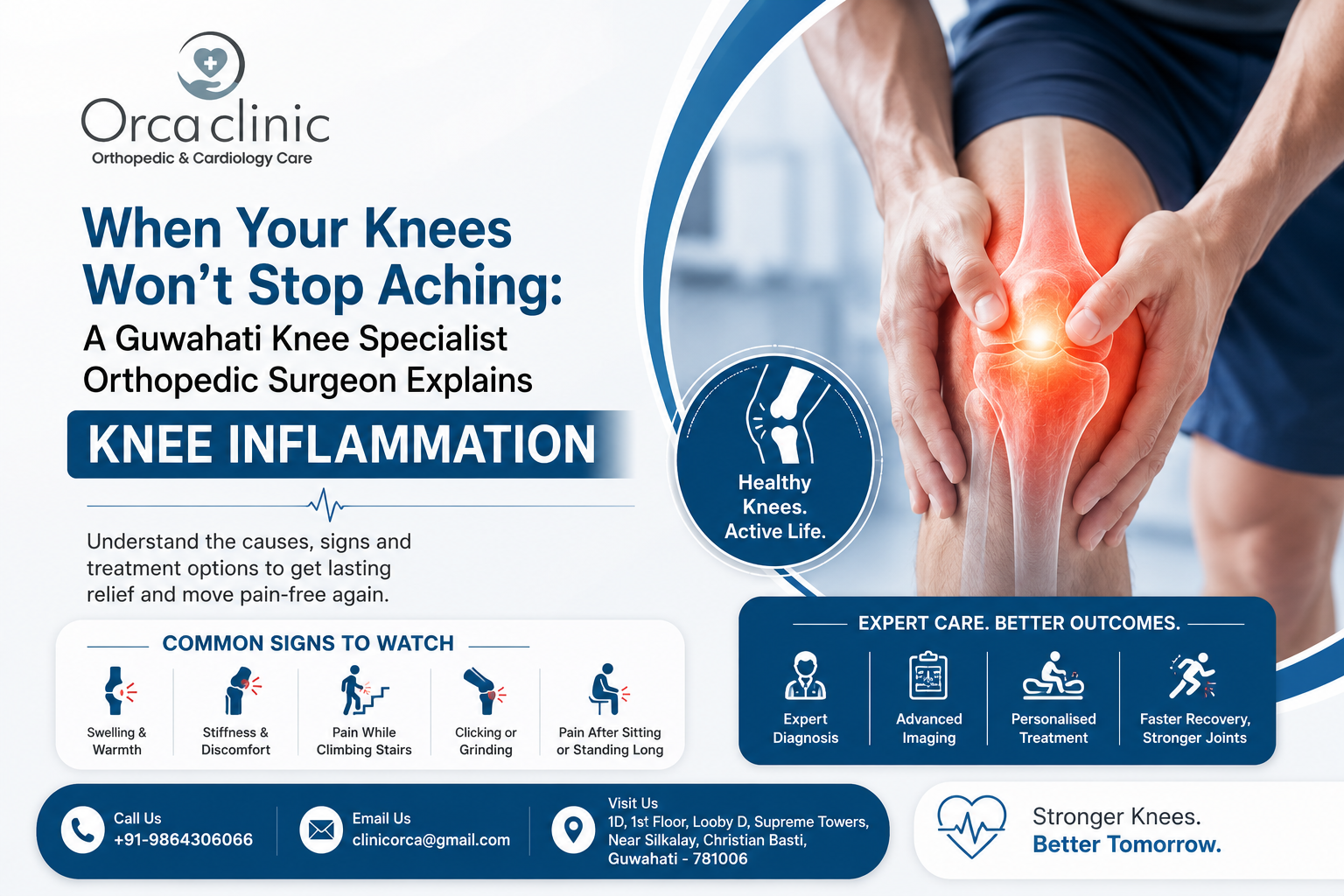
When Your Knees Won’t Stop Aching: A Guwahati Knee Specialist Orthopedic Surgeon Explains Knee Inflammation
Almost every knee patient who walks into Orca Clinic starts the conversation the same way: “It was manageable for months, and now I cannot sit on the floor or climb stairs without wincing.” That gradual build-up is exactly how knee inflammation behaves quiet at first, then impossible to ignore.
If you have been searching for a knee specialist orthopedic surgeon in Guwahati because your knee feels swollen, warm, or stiff more often than not, this guide walks you through what is actually happening inside the joint, why it’s so common here, and what real treatment looks like from the first consultation to full recovery.
What Is Knee Inflammation and Why Is It So Common in Guwahati?
Knee inflammation occurs when the tissues around the joint the synovial lining, cartilage, or surrounding ligaments react to irritation, wear, or injury by swelling and producing excess fluid. In the short term, this is the body’s natural defense mechanism. Left unaddressed, it becomes a cycle: swelling restricts movement, restricted movement weakens supporting muscles, and weaker muscles put more strain on the joint.
Guwahati’s daily habits play a role too. Floor seating during meals and prayers, squatting-style toilets in many older homes, uneven pavements, and long commutes on two-wheelers all place repeated stress on the knees. Add the region’s humid climate, which many patients say makes joint stiffness feel worse, and it’s easy to see why knee complaints are one of the most frequent reasons people consult an orthopedic clinic in the city.
Recognizing the Signs Before You See a Knee Specialist Orthopedic Surgeon in Guwahati
Not every ache needs a doctor’s visit, but certain patterns are worth paying attention to:
- Visible puffiness around the kneecap, especially after standing or walking
- A knee that feels warm to the touch compared to the other side
- Stiffness that is worse first thing in the morning or after sitting for long periods
- A clicking, grinding, or catching sensation while bending the knee
- Pain that gets worse when climbing stairs, squatting, or getting up from a chair
- Reduced range of motion — difficulty fully straightening or bending the leg
If these symptoms persist beyond a week or return repeatedly, it’s a sign the joint needs a proper evaluation rather than more rest and ointment.
What Actually Causes Knee Inflammation?
Patients are often surprised to learn that “inflammation” isn’t one single condition. It’s a symptom with several possible root causes:
Osteoarthritis — the most common cause in patients over 45, where cartilage gradually wears down and the joint reacts with swelling and stiffness.
Rheumatoid arthritis — an autoimmune condition where the body’s immune system attacks the joint lining, often affecting both knees at once.
Overuse and repetitive strain — common in people who stand for long hours at work, or in younger patients who train intensively without adequate recovery.
Ligament or meniscus injuries — a sudden twist during sport or a missed step on stairs can trigger swelling that lingers if the underlying tear isn’t treated.
Gout or infection-related inflammation — less common, but these cause sudden, intense swelling and need urgent medical attention.
Old, healed fractures around the joint — trauma from years ago can quietly progress into post-traumatic arthritis, a condition we also treat at our trauma and fracture care unit in Guwahati.
How a Knee Specialist Orthopedic Surgeon in Guwahati Reaches a Diagnosis
Because so many conditions can cause similar swelling, the diagnostic process is where accurate treatment planning really begins. At Orca Clinic, a consultation typically includes:
- A detailed history of when the swelling started, what makes it worse, and any past injuries
- A physical examination checking range of motion, joint stability, and warmth or fluid buildup
- X-rays to assess cartilage space, alignment, and bone changes
- MRI scans where soft tissue, ligament, or cartilage damage is suspected
- Blood tests in cases where an inflammatory or autoimmune cause is suspected
This structured approach avoids guesswork treatment is based on what’s actually driving the inflammation, not just the symptom itself.
Treatment Options for Knee Inflammation in Guwahati
Most patients are relieved to hear that surgery is not the first step. Treatment usually follows a graded approach:
Conservative management — activity modification, targeted physiotherapy, anti-inflammatory medication, and in some cases, joint fluid aspiration or injections to reduce swelling and improve mobility.
Bracing and support — for patients with mild instability or early-stage arthritis, supportive bracing can reduce strain while muscles are strengthened.
Sports and activity-related injuries — where inflammation stems from ligament or meniscus damage, our sports injury management program focuses on restoring stability before it progresses further.
Surgical intervention — reserved for patients with advanced joint damage, cartilage loss, or arthritis that no longer responds to conservative care. For these cases, our detailed guide on joint and knee replacement surgery in Guwahati explains what total and partial knee replacement involve, along with realistic recovery timelines.
The goal at every stage is the same: use the least invasive option that gives lasting relief, and move to surgery only when it clearly offers a better outcome than continued conservative care.
When Knee Inflammation Needs More Than Home Remedies
Ice packs, rest, and over-the-counter gels have their place, but certain situations call for prompt medical attention rather than self-management:
- Sudden, severe swelling after a fall, sports injury, or accident
- A knee that gives way or feels unstable when bearing weight
- Fever accompanying joint swelling, which may indicate infection
- Swelling that keeps returning despite weeks of rest and medication
- Visible deformity or inability to bear any weight on the leg
Injury-related swelling in particular should never be brushed aside untreated ligament or fracture-related trauma can quietly develop into long-term joint damage. Our trauma and fracture treatment team regularly manages exactly these cases, including pediatric injuries where growing bones need specialized handling.
Practical Ways to Protect Your Knees Day to Day
A few adjustments, especially suited to daily life in Guwahati, can meaningfully reduce the load on your knees:
- Switch to a Western-style toilet or use a raised seat if floor squatting is uncomfortable
- Use a low stool instead of sitting cross-legged on the floor for extended meals or gatherings
- Wear supportive, cushioned footwear rather than flat slippers, especially on uneven roads
- Maintain a healthy body weight every extra kilogram adds measurable pressure on the knee joint
- Build quadriceps and hamstring strength through simple, guided exercises rather than high-impact workouts
- Avoid sitting or standing in one position for long stretches; short movement breaks help circulation
These habits won’t reverse existing joint damage, but they go a long way in slowing progression and easing daily discomfort.
Why Patients in Guwahati Choose Orca Clinic for Knee Care
Orca Clinic is led by Dr. Abhay Agarwal, an orthopedic specialist with a patient-first approach to diagnosing and treating knee conditions from early-stage inflammation to advanced joint replacement. Rather than pushing every patient toward surgery, the clinic’s philosophy centers on evaluating each case individually and recommending treatment only where it offers real, lasting benefit.
What sets the experience apart:
- Thorough clinical evaluation backed by imaging, not assumptions
- Transparent explanation of treatment options, including what non-surgical care can realistically achieve
- Coordinated care for related conditions from sports injuries to arthritis to fracture-related joint damage
- A structured recovery and rehabilitation plan for every surgical patient
You can read more about Dr. Agarwal’s background and approach on the About Dr. Abhay Agarwal page, and browse patient experiences and further reading on orthopedic and cardiac health on our health blog.
Frequently Asked Questions
What does knee inflammation feel like in the early stages?
Early knee inflammation often feels like mild stiffness in the morning or after sitting for a while, sometimes with slight puffiness around the kneecap. It may ease with movement initially, which is why many people delay seeking care until the swelling becomes more frequent or painful.
Is knee inflammation the same as arthritis?
Not always. Inflammation is a symptom that can result from arthritis, but it can also stem from an injury, overuse, infection, or an autoimmune condition. A knee specialist orthopedic surgeon evaluates the underlying cause before recommending treatment, since arthritis-related swelling is managed differently from injury-related swelling.
Can knee inflammation in Guwahati be linked to lifestyle habits?
Yes. Floor seating, squatting toilets, uneven walking surfaces, and standing for long hours at work are common contributing factors seen in patients across the city. Adjusting these habits alongside medical treatment often improves outcomes.
Do I need surgery if my knee is swollen?
Most cases of knee inflammation respond well to conservative treatment such as physiotherapy, medication, and lifestyle changes. Surgery is only considered when imaging confirms significant joint damage or when non-surgical treatment fails to provide lasting relief.
How long does it take to see improvement with treatment?
It varies by cause. Overuse-related inflammation often improves within a few weeks of rest and physiotherapy, while arthritis-related swelling may need ongoing management. Your orthopedic surgeon will give you a realistic timeline based on your diagnosis and imaging results.
When should I see a knee specialist orthopedic surgeon in Guwahati instead of waiting it out?
If swelling persists beyond a week, keeps recurring, is accompanied by warmth or fever, or limits your ability to walk or bear weight, it’s time for a proper evaluation rather than continued self-care at home.
Can children develop knee inflammation too?
Yes, particularly after falls, sports activities, or growth-related joint stress. Because children’s bones and joints are still developing, pediatric knee complaints should be assessed by a specialist experienced in paediatric orthopedic care to avoid long-term growth complications.
What should I bring to my first consultation?
Any previous X-rays, MRI reports, or prescriptions related to your knee, along with a clear timeline of when the swelling started and what activities worsen it. This helps the surgeon reach an accurate diagnosis faster.
Book a Consultation with Our Knee Specialist Orthopedic Surgeon in Guwahati
Persistent knee inflammation rarely resolves on its own, and the longer it is left unaddressed, the more it can affect your mobility and daily comfort. If your knee has been swollen, stiff, or painful for more than a few days, it is worth getting it properly evaluated.
Book Your Appointment with Orca Clinic’s orthopedic team today.