








Trauma Management in Guwahati: Why Your Heart Deserves Attention During Recovery Too
If you or a family member has ever been rushed to a clinic after a fall, a road accident, or a sudden fracture, you already know how chaotic those first few hours can feel. Doctors move fast, X-rays get done, and a treatment plan is put in place almost before the shock wears off. What often gets missed in that rush, though, is a quieter question that matters just as much: how is the patient’s heart holding up through all of this?
At Orca Clinic in Christian Basti, Guwahati, this is a conversation Dr. Abhay Agarwal and Dr. Shilpi Lahoty have with patients almost every week. Trauma and cardiac health are usually treated as two separate worlds one handled by an orthopedic team, the other by a cardiologist. In real life, especially for patients above 45, or anyone already living with high blood pressure, the two are closely connected. This blog looks at why that connection matters, and what it means for anyone searching for trauma care or heart-related treatment in the city.
Trauma Management in Guwahati: What Actually Happens After an Injury
Trauma isn’t a single event with a single fix. It usually plays out in stages:
- Immediate stabilisation – controlling pain, checking for fractures or dislocations, and ruling out internal injury
- Diagnosis – imaging to understand exactly what’s broken or damaged
- Treatment – surgical or non-surgical correction, depending on severity
- Recovery and rehabilitation – the part that’s often underestimated, but decides how well someone actually heals
At Orca Clinic,trauma and fracture treatment covers everything from simple fractures to more complicated polytrauma cases involving multiple injuries, as well as fractures in children, which need a more careful, age-appropriate approach. But one detail that’s easy to overlook: a patient’s fitness for surgery, especially under anaesthesia, depends heavily on how stable their blood pressure and heart function are. This is exactly where cardiac screening becomes part of trauma planning, not an afterthought.
Why a Hypertension Specialist in Guwahati Should Be Involved Early, Not Later
High blood pressure rarely announces itself with obvious symptoms. Many people walk into a clinic for a fracture and only discover, almost incidentally, that their blood pressure has been dangerously high for months. This matters a great deal in trauma cases because:
- Uncontrolled hypertension increases surgical risk, including bleeding and delayed healing
- Pain and stress from an injury can spike blood pressure further, especially in someone whose condition wasn’t well managed to begin with
- Certain pain medications and anaesthesia decisions have to be adjusted for patients with high BP or existing heart conditions
This is why, at Orca Clinic, a hypertension specialist in Guwahati is often brought into the picture alongside the orthopedic team when a trauma patient has a known history of high blood pressure or high cholesterol. Rather than treating the fracture and the blood pressure as two separate problems, the goal is one coordinated recovery plan medication adjustments, lifestyle guidance, and close monitoring, all working toward the same outcome: a patient who heals safely and does not end up back in a clinic for a cardiac complication a few months later.
When You Need a Heart Related Doctor in Guwahati During or After Trauma Care
It is not only pre-existing conditions that matter. Trauma itself can put unusual strain on the heart, particularly in:
- Older adults recovering from hip or long-bone fractures, who are at higher risk of clotting and reduced mobility
- Patients with chest wall injuries from accidents, where cardiac bruising or irregular heartbeat needs to be ruled out
- Anyone reporting breathlessness, chest tightness, or unusual fatigue during recovery, none of which should be dismissed as “just the injury”
A heart related doctor in Guwahati at Orca Clinic typically runs a comprehensive cardiac evaluation for such patients, including ECG, ECHO, or Holter monitoring where needed, so that recovery isn’t interrupted by a cardiac issue that could have been caught earlier. We have written more about the early warning signs worth watching for in our post on subtle heart trouble symptoms and our early heart screening checklist for Guwahati residents, both worth a read if you or a family member falls into a higher-risk group.
How Orca Clinic Brings Orthopedic and Cardiology Care Under One Roof
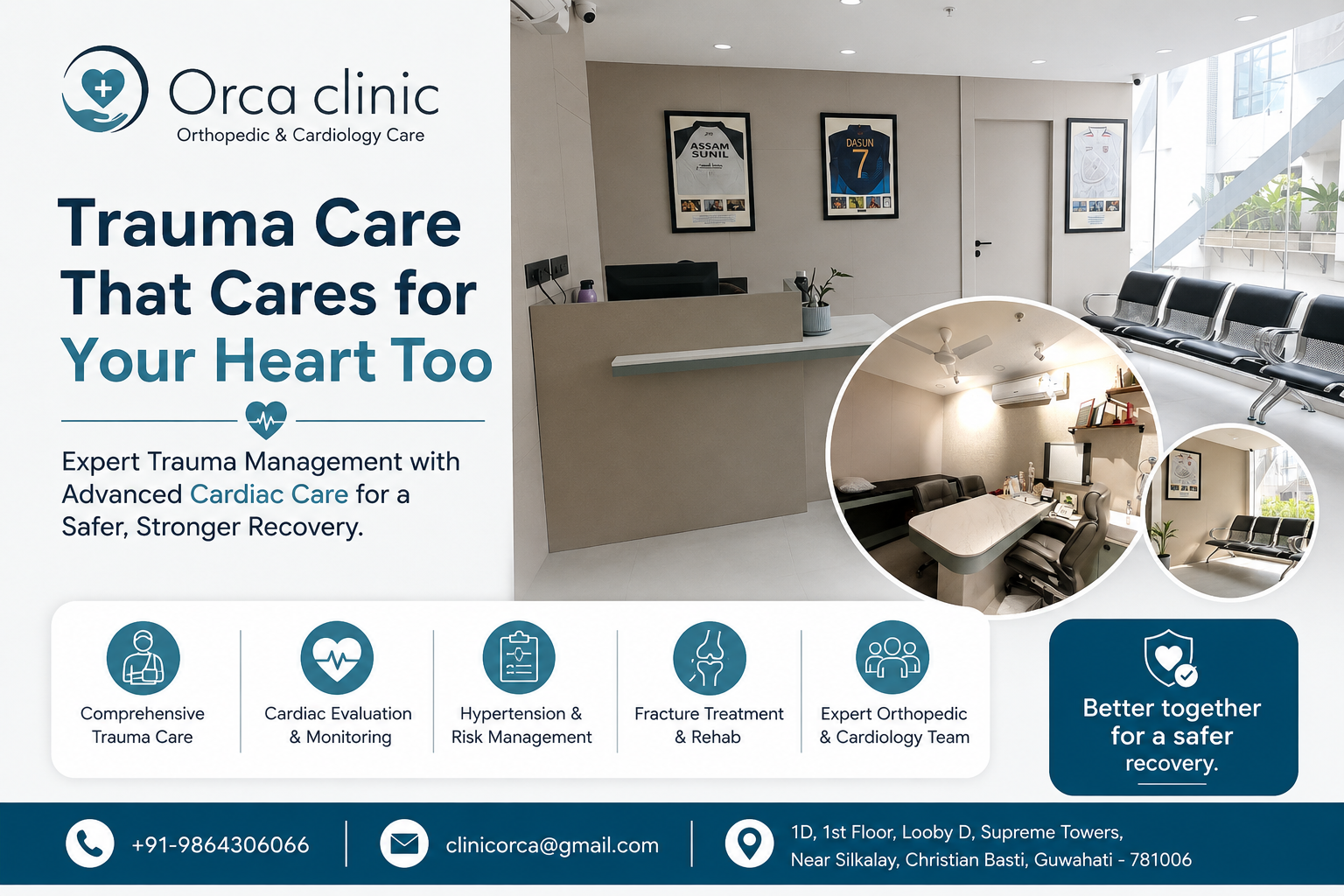
What makes this coordinated approach possible is fairly simple: Orca Clinic was built around two specialities working together rather than in isolation. Dr. Abhay Agarwal leads orthopedic and trauma care, while Dr. Shilpi Lahoty oversees cardiology services, and the two teams routinely consult on patients where both specialities intersect post-surgical patients with hypertension, elderly trauma cases, or anyone whose recovery plan needs input from both sides.
This is not a marketing angle; it is a practical necessity in a city like Guwahati, where patients often do not have the time or means to shuttle between multiple clinics for related issues. If you’re looking into sports injury management or joint replacement surgery alongside a cardiac concern, having both teams in one location, at 1D, 1st Floor, Looby D, Supreme Towers, Christian Basti, Guwahati, tends to make the whole process considerably less stressful.
Practical Steps If You’re Managing Trauma Recovery Alongside a Heart Condition
A few things we consistently tell patients and their families:
- Don’t skip the blood pressure check just because you’re there for a fracture. It takes two minutes and can change the entire treatment plan.
- Mention any chest discomfort, however minor, during your orthopedic follow-up. It’s easier to flag early than to explain away later.
- Ask about medication interactions. Painkillers and BP medications don’t always mix well, and this is worth a direct conversation with your doctor.
- Keep rehabilitation gradual. Rushing physical activity post-injury puts unnecessary strain on a heart that’s already compensating for reduced mobility.
- Get a cardiac evaluation before major orthopedic surgery, especially if you’re over 45 or have a family history of heart disease.
You can find more everyday guidance in our post on lifestyle habits that quietly harm both your heart and joints.
Frequently Asked Questions
What does trauma management in Guwahati typically involve at Orca Clinic?
It usually starts with stabilising the injury, followed by diagnostic imaging, then either surgical or non-surgical treatment depending on the severity of the fracture or dislocation. Rehabilitation and monitoring continue afterward to make sure mobility and function are fully restored, with special attention paid to pediatric fractures and complex trauma cases.
Why would a hypertension specialist in Guwahati be involved in an orthopedic case?
Because uncontrolled blood pressure can complicate surgery, slow down healing, and increase the risk of complications during anaesthesia. A specialist manages BP alongside the orthopedic treatment so recovery isn’t disrupted by an undiagnosed or poorly controlled cardiac risk factor.
When should I see a heart related doctor in Guwahati after an accident or fall?
If you are experiencing chest discomfort, breathlessness, unusual fatigue, dizziness, or swelling in the legs during recovery, it’s worth getting a cardiac evaluation rather than assuming it’s simply related to the injury. Older adults recovering from major fractures are also generally advised to get a baseline heart check.
Is it necessary to get a cardiac evaluation before orthopedic surgery?
For many patients, yes, particularly those over 45, those with existing hypertension or high cholesterol, or anyone with a family history of heart disease. It’s a standard precaution that helps the surgical team plan safely around the patient’s overall health, not just the injury itself.
Does Orca Clinic treat both trauma and heart-related conditions at the same location?
Yes. Orca Clinic combines orthopedic and cardiology care under one roof in Christian Basti, Guwahati, allowing patients with overlapping concerns, such as a fracture alongside high blood pressure, to be treated by both teams without needing to visit separate clinics.
Can high blood pressure affect fracture healing or trauma recovery?
It can. Poorly controlled hypertension is linked to slower wound healing, increased bleeding risk during surgery, and a higher chance of complications during the recovery period. This is why blood pressure management is often built into the trauma care plan rather than treated as an unrelated issue.
If you are currently recovering from an injury and also managing high blood pressure, cholesterol, or any heart-related concern, it is worth having both conversations with your doctor at the same visit rather than two separate ones.
You canbook an appointment with Orca Clinic or call +91-9864306066 to speak with the team directly. You can also browse more patient guidance on our health blog.