








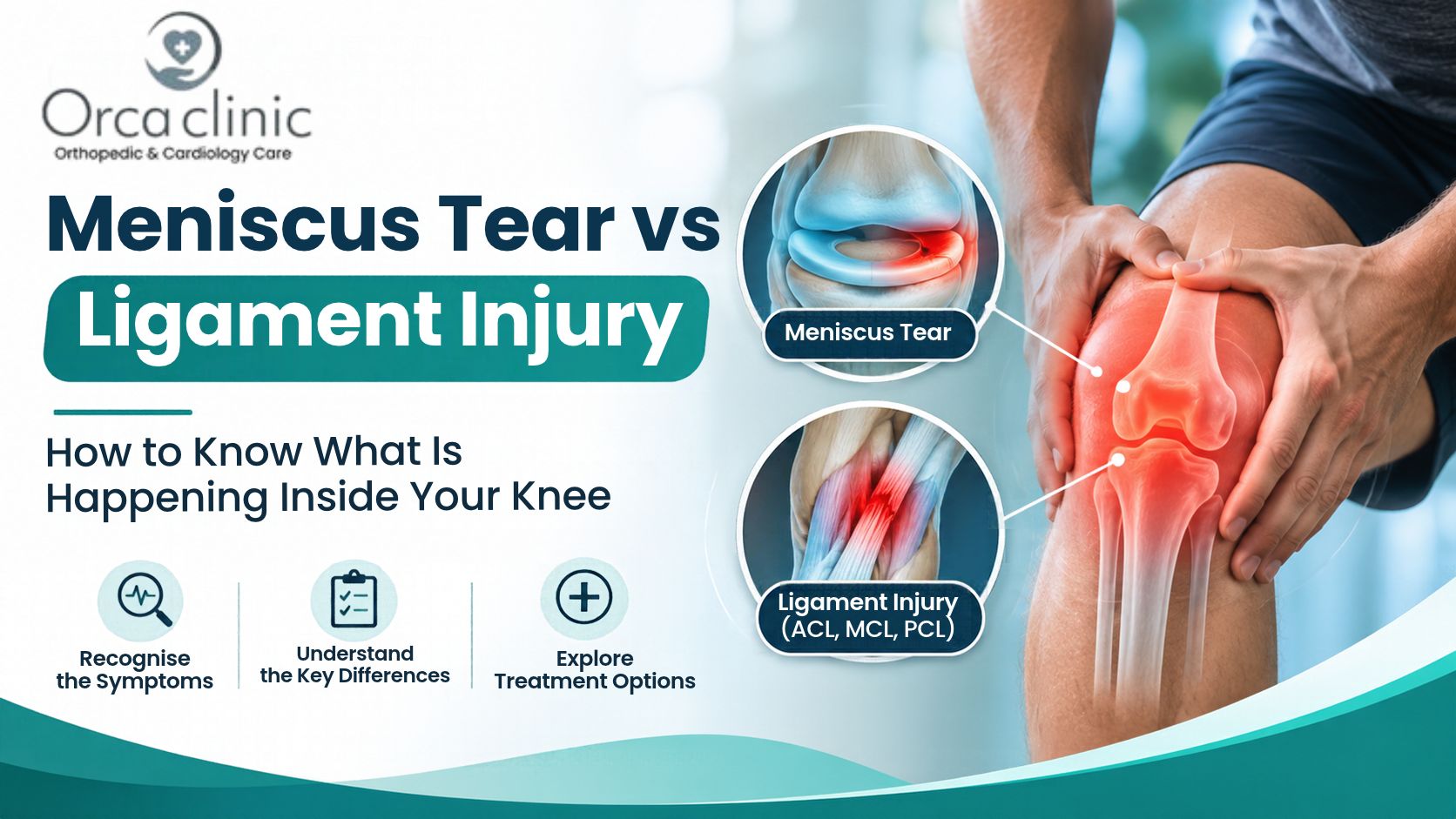
Meniscus Tear vs Ligament Injury: How to Know What Is Happening Inside Your Knee
You were fielding at point, turned sharply to chase the ball, and your foot stayed planted while the rest of you kept going. The knee twisted. Maybe you heard a pop, maybe you felt only a deep, hot ache. You stayed on for the last few overs. By evening the knee was puffy, and the next morning it would not straighten all the way.
Two quite different injuries can begin exactly like this: a torn meniscus or a torn ligament. The first hour feels almost the same. The next few days do not, and neither does the treatment. This guide explains what sits inside your knee, which clues separate one injury from the other, what “locking” really means, and when orthopedic knee surgery in Guwahati is a sensible option and when it is not. It will help you describe your injury clearly to a doctor. It cannot replace an examination.
What Is Inside Your Knee: Meniscus and Ligaments in Plain Words
Your knee is where the thigh bone (femur) meets the shin bone (tibia), with the kneecap in front. Two kinds of soft structures keep this joint working.
The menisci are two C-shaped pads of cartilage, one on the inner side and one on the outer side. They cushion the joint, spread your body weight and add a little stability. Think of them as shock absorbers.
The ligaments are tough bands connecting bone to bone. The ACL and PCL cross inside the joint, and the MCL and LCL run along its inner and outer sides. Think of them as the guy ropes of a tent: they keep everything from shifting where it should not.
Here is the idea that makes the rest of this article easy. A ligament injury is mostly a stability problem, so the knee feels like it may give way. A meniscus injury is mostly a mechanical problem, so the knee catches, clicks or gets stuck.
Meniscus Tear: Signs That Point to Cartilage Trouble
A meniscus usually tears when the knee twists while the foot is fixed on the ground, such as a pivot on a wet outfield or a deep squat with a turn. Typical clues include:
- Pain along the joint line, on the inner or outer side of the knee
- Swelling that builds slowly over a day or two rather than within minutes
- A catching or clicking feeling, as if something small is trapped inside
- Pain when squatting, twisting, or sitting cross-legged on the floor
- In some cases, true locking of the knee (explained below)
In people above 40, the meniscus may already be worn and can tear with a very ordinary movement, such as getting up from a low seat. This degenerative pattern is closely tied to early wear of the joint, which we discuss in our guide to arthritis in your 30s, 40s or 50s.
Ligament Injury: ACL, MCL and PCL Signs
Ligaments are usually hurt by sudden stops, awkward landings, or a direct blow. Each has its own story.
ACL (anterior cruciate ligament). This is the classic cricket, football and badminton injury. Many people report a loud pop, immediate swelling within a few hours, and a knee that feels unsafe when they turn, step down stairs or try to run. Most cannot carry on playing.
MCL (medial collateral ligament). It is often injured by a blow to the outer side of the knee. The pain is along the inner side. Most MCL sprains settle with a brace and structured rehabilitation.
PCL (posterior cruciate ligament). Less common, and typically caused by a fall onto a bent knee or a dashboard impact in a road accident. The pain is felt at the back of the knee.
Combined injuries are common. A torn ACL often comes with a meniscus tear or MCL sprain, which is why a careful examination matters more than a quick guess.
Meniscus Tear vs Ligament Injury: A Side-by-Side Comparison
| Meniscus tear | Ligament injury (such as ACL) | |
| Usual cause | Twist on a planted foot, deep squat | Sudden stop, pivot, awkward landing, direct blow |
| At the moment of injury | Often mild, sometimes no clear event | Frequently a pop, and play stops |
| Swelling | Slow, over 1 to 2 days | Fast, within hours |
| Main sensation | Catching, clicking, locking | Giving way, instability |
| Pain pattern | Along the joint line, worse on twisting | Deep inside or along the side |
| Squatting | Painful or blocked | Possible, but the knee feels untrustworthy |
Treat this table as a guide, not a verdict. Overlap is common, and only an examination can sort it out.
Knee Locking and Trouble Putting Weight on the Leg: What It Really Means
These two symptoms worry people the most, so they deserve a clear explanation.
True locking means the knee is physically blocked. You cannot straighten the last stretch, and it feels stuck in a bent position. This often happens when a torn piece of meniscus folds into the joint. Sometimes a gentle movement frees it, and sometimes it does not. Do not force it. A knee that stays stuck should be examined within days, not weeks.
Pseudo-locking is different. The knee will not straighten because of pain, swelling or muscle guarding, not because something is blocking it. It is still a reason to get checked, but it is less likely to be a displaced tear.
Difficulty bearing weight has to be handled carefully. If you cannot take four steps straight after the injury, a fracture must be excluded with an X-ray before anything else is assumed. A ligament tear usually leaves you feeling unstable more than unable to stand, while a meniscus tear can make you limp because of pain.
What to Do in the First 48 Hours, and Red Flags You Should Not Ignore
Stop playing straight away, even if the pain settles. Rest the knee, apply a cold pack wrapped in a cloth for 15 to 20 minutes at a time, use a firm but not tight compression bandage, and keep the leg raised. Use a stick or crutch if you are limping. Avoid heat, oil massage and “running it off” on a fresh, swollen knee, because they can make swelling and damage worse.
Get seen quickly if you notice any of the following:
- You cannot bear weight or take four steps
- The knee looks deformed or the kneecap seems out of place
- The knee is locked and will not straighten
- The foot is numb, pale or cold
- A hot, red, swollen knee comes with fever
- Major swelling appears after a high-speed fall or road accident
How an Orthopedic Doctor in Guwahati Diagnoses Knee Injuries
A good diagnosis begins with listening. An experienced orthopedic doctor in Guwahati will ask how the injury happened, whether you heard a pop, when the swelling started, and whether the knee has locked or given way.
The examination compares both knees. The doctor checks swelling, range of motion, and tenderness along the joint line, and performs specific stability tests: the Lachman and drawer tests for the ACL and PCL, stress tests for the side ligaments, and McMurray and Thessaly tests for the meniscus.
An X-ray does not show soft tissue, but it rules out fractures and avulsion injuries. An MRI shows the meniscus and ligaments clearly and is usually advised when the diagnosis is uncertain or surgery is being planned.
One point is worth stating plainly: scans must be read alongside the patient. Many people over 40 have meniscus changes on an MRI without any symptoms. The decision to treat should rest on your symptoms, your examination and your goals, not on the scan report alone.
When Is Orthopedic Knee Surgery in Guwahati Actually Needed?
Most knee injuries do not need an operation, and anyone who tells you otherwise without examining you deserves a second opinion. Surgery becomes a reasonable discussion in situations like these:
- A knee that is truly locked and does not unlock, suggesting a displaced meniscus tear
- A repairable meniscus tear in a young, active person, where saving the meniscus protects the joint in the long run
- A complete ACL tear with repeated giving way in someone who wants to return to cricket, football, badminton or other pivoting sports, or whose work demands a stable knee
- Combined injuries, such as an ACL tear with a meniscus tear or multiple torn ligaments
- Ongoing pain, swelling or instability after a properly supervised rehabilitation period
- Fractures or bone avulsions around the knee
Surgery is often not the first answer for:
- Small, stable meniscus tears, and degenerative tears in older adults, where physiotherapy is usually tried first
- MCL sprains and partial ligament tears
- ACL tears in people with lower-demand lifestyles who do well with focused strengthening
When surgery is advised, it is commonly done arthroscopically, meaning through small keyhole incisions. A meniscus may be repaired or, when repair is not possible, partly trimmed. A torn ACL is typically rebuilt with a graft. Dr. Abhay Agarwal has fellowship training in arthroscopy and sports injuries, and arthroscopic surgery is part of the care offered at Orca Clinic.
One more point of clarity. If knee pain comes from advanced wear of the joint rather than an injury, the conversation is different, and joint replacement surgery may be what is discussed. It is not a treatment for a torn meniscus in a younger knee.
Choosing a Knee Specialist Orthopedic Surgeon in Guwahati
When you are comparing options, look beyond the title. A knee specialist orthopedic surgeon in Guwahati should have training in arthroscopy and sports medicine, should examine you properly before recommending a scan or surgery, and should explain the non-surgical route as clearly as the surgical one. You should leave the clinic knowing what is injured, what the choices are, and what each one costs you in time.
Dr. Abhay Agarwal completed his orthopedic residency at Dr. D.Y. Patil Medical College in Navi Mumbai and holds a Diploma in Sports and Exercise Medicine from the University of South Wales. He has also completed fellowships in sports injuries, arthroscopy, sports medicine and minimally invasive joint surgery. You can read more on his profile page, and our earlier article on what a knee specialist orthopedic surgeon in Guwahati can help with covers the broader picture. If your knee swells and aches without a clear injury, this guide to knee inflammation may fit your situation better.
Sports Orthopedic in Guwahati: Sports Injury Management and the Road Back to Cricket
Whether you are treated with or without surgery, rehabilitation decides how well the knee works afterwards. Good sports orthopedic care in Guwahati follows stages: calm the swelling, regain full straightening and bending, rebuild thigh, hip and calf strength, retrain balance, then slowly add jogging, cutting and sport-specific drills.
Return to play should be based on how the knee performs, not on the calendar. As a rough guide, many athletes need nine months or more after ACL reconstruction. Meniscus repairs also ask for patience, since the healing tissue must be protected. Going back early is one of the most common reasons for a second injury.
Our Sports Injury Management service is built around this approach: accurate diagnosis first, then a plan that matches your sport, your age and your goals.
Sports Injury Prevention in Guwahati: Habits That Protect Your Knees
Not every knee injury can be prevented, but a good number can be made less likely. These habits matter most for weekend cricketers and club-level players:
- Warm up with dynamic movements such as leg swings, light jogging and lunges, instead of static stretching alone
- Strengthen the quadriceps, hamstrings, glutes and core, because strong muscles share the load that ligaments would otherwise carry
- Practise landing softly with bent knees, and do not let the knees collapse inward
- Be careful on wet or uneven grounds during the monsoon, and wear footwear suited to the surface
- Increase training load gradually after a break instead of jumping straight back to full matches
- Do not play through a swollen knee, and treat late-innings fatigue as a risk, since tired muscles protect the joint less well
If you have had a knee injury before, a short assessment can pinpoint weak links before they cause a new problem.
Trauma Management in Guwahati: When a Knee Injury Is More Than a Sprain
A fall from a bike or a road accident can damage far more than one structure. High-energy knee injuries can involve fractures, several ligaments at once, and sometimes the blood vessels or nerves behind the knee. That is why prompt trauma management in Guwahati begins with a careful look for fractures and circulation problems before any ligament is discussed.
Our Trauma & Fracture Treatment service covers fractures, dislocations and soft tissue injuries. Recovery from a major injury also puts strain on the rest of the body, and we have written about why heart health deserves attention during trauma recovery.
Frequently Asked Questions
Can a torn meniscus heal on its own?
It depends on where the tear sits and what kind it is. The outer rim has a better blood supply and may heal, while tears deeper in the cartilage heal poorly. Small stable tears often settle with rehabilitation. A doctor can tell you which type you have.
Can I walk normally with a torn ACL?
Many people can walk on flat ground, but the knee may give way when turning, stepping down or playing sport. Repeated giving way can damage the meniscus and cartilage over time, so it should not be ignored.
How long can I wait before seeing a doctor?
If you can bear weight and the swelling is settling, a few days of rest is reasonable. If the knee is locked, deformed, very swollen, or you cannot bear weight, go the same day.
Is an MRI always necessary?
No. The examination often points strongly to the diagnosis. An MRI helps when the picture is unclear, when injuries may be combined, or when surgery is being planned.
Does knee locking always mean I need surgery?
Not always. A knee that unlocks and stays free may be managed without surgery, while one that stays stuck often needs a procedure. Either way, locking calls for an evaluation.
Where can I find more answers on bone and joint care?
Our orthopedic FAQ answers common questions, and the Orca Clinic blog has more guides.
Book a Knee Consultation at Orca Clinic, Guwahati
If your knee has twisted, locked, swollen or given way, an examination is the fastest way to replace guesswork with a plan. Dr. Abhay Agarwal will assess your knee, advise on imaging only if it is needed, and explain your options, including the ones that do not involve surgery.